
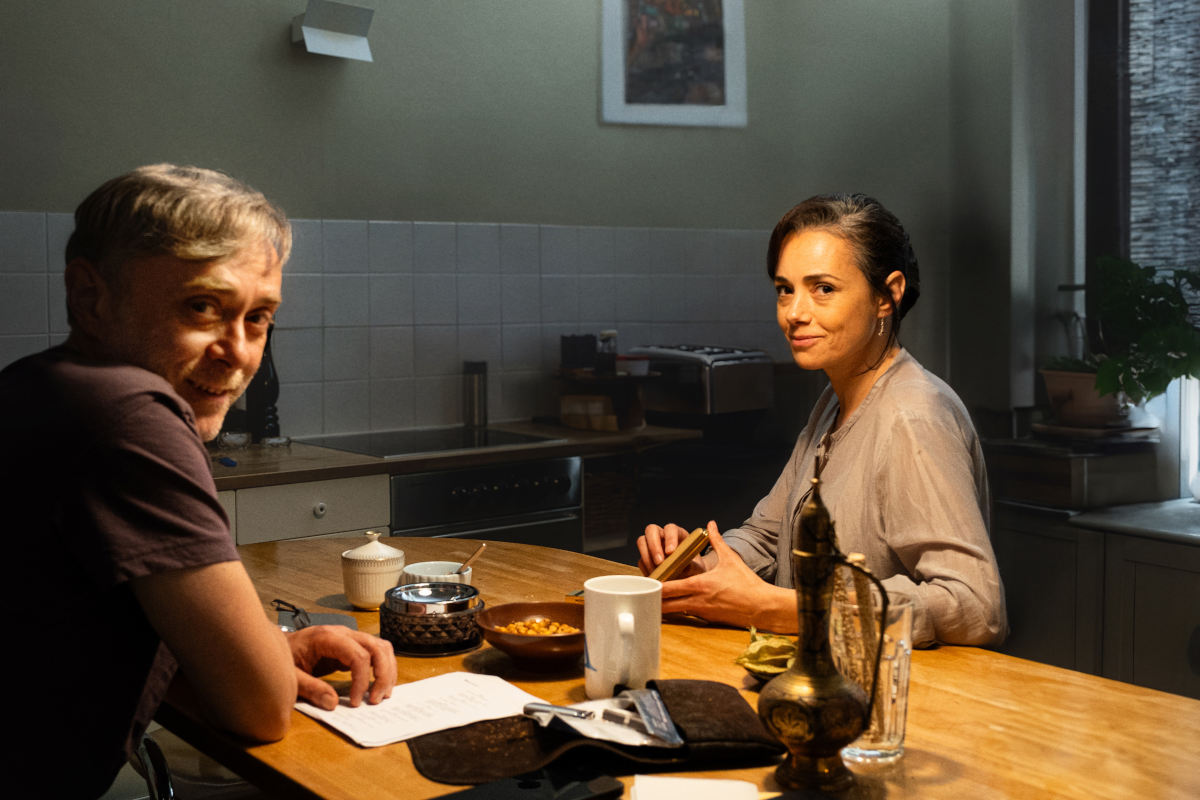
Vassiis Kroustallis reviews the Golden Bear film 'Yellow Letters' by İlker Çatak.
'Yellow Letters' are the slips the Turkish government issues to summon all those who were considered somehow suspect for crimes for further interrogation and/or court proceedings. In the 2026 eponymous (and well-crafted) drama by the German (of Turkish origin) İlker Çatak (The Teacher Lounge), this phrase becomes the catalyst for a series of actions.
Between 2016 and 2019, around 2,000 artists were suspended and taken to court by the Turkish government because they’d signed a peace petition; academics were also a ready target. In 'Yellow Letters', we have both cases in a single couple. Derya (Özgü Namal) and Aziz (Tansu Biçer) are a middle-aged actress and a writer-University teacher, respectively, in Ankara's National State Theatre; trying to experiment with socially conscious art -yet at the same time, they won't capitulate to the government's desires (Derya will refuse a photo opportunity with the state governor). Their devoted but mildly rebellious teenage daughter, Ezgi (Leyla Smyrna Cabas), tells them frankly that art will not save the world -the next morning, the whole family will realize the opposite: that the world can destroy their art.
Aziz and his colleagues will be readily dismissed from the university where they teach, and Derya will be asked not to reprise her role in Aziz's play. She refuses, and the whole family (now jobless) will move to Istanbul, where they will be hosted by Aziz's mother, Güngör Hanim (İpek Bilgin). İlker Çatak skillfully navigates the family and social space of the in-between, between the fall from a respected social status and the potential of country (self) exile. This is the space the whole family has to map through and stay together -or not. In the film, the state powers are nowhere present -they are only the invisible, talked-about force everyone is counting against (but judges and their power feature prominently in the film's brief courtroom scene).
Sober but narratively kinetic and easy to follow, 'Yellow Letters' swiftly and fluidly moves to face the uncertainty of situations and the increasing fictions that enter into the marriage. Joblessness, a new adherence to religious custom, a late attempt at assimilation (deleting incriminating Facebook posts has its own space in the film, once again tellingly about the power of social media). And Ezgi becomes its own roller-coaster of emotions that each parent wants to control.
While the film rightfully doesn't go for harsh surprises (and violence is only shown on the streets), at times it seems unsure whether to move into the final confrontation (a superb car scene between Derya and Aziz) or linger on plotlines that don't always lead to consequences. Its visual placement in Germany (Berlin and Hamburg) is the only sign of an agitprop intervention, with title cards announcing exactly this dislocation (Berlin as Ankara, Hamburg as Istanbul) which accompanies the character's everyday personal and sentimental dislocation.
Camerashots and production design here serve the everyday trading of negotiations (only the theater environment is left in consistent monochromes and big, readily identifying structures). The whole cast offers a top-notch dialectic of uncertainty, and the continuity between acting in theater/TV (for both the main couple) and reacting in real life is also effectively stretched -as if real life is the best theatrical performance of its time.
'Yellow Letters' has a lot to say about the vicious trend of authoritarianism, which uses uncertainty in life (personal, family, societal) as its main weapon of dominance. It tends to be rather timid at times when describing a failing relationship, but it always hits its target. It successfully presents its content of artists and intellectuals as players who may (and should) experience life's fragility against a power that only knows of letters (rather than sentences and context).
The film 'Yellow Letters' screened at the 76th Berlin Film Festival (Golden Bear).
Vassilis Kroustallis
