About Us
Film Is A Fine Affair details the views and reviews of Vassilis Kroustallis, on independent cinema. Legally represented by Scheriaa Productions
Vassilis Kroustallis reviews the Spanish queer film 'La Bola Negra'
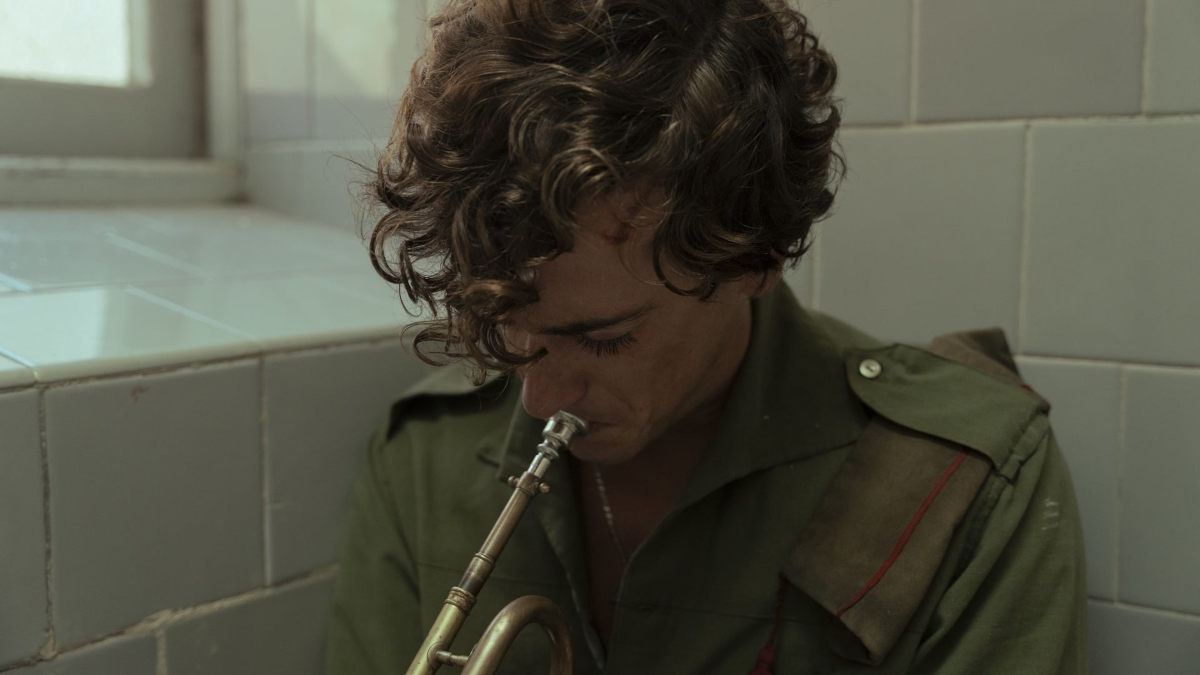
There is a certain moment in 'La Bola Negra' (The Black Ball), the 2026 queer drama film by Javier Calvo and Javier Ambrossi, when one of the main characters of the 1937 plot, the Nationalist-serving soldier Sebastian (the singer-songwriter Guitarricadelafuente, in his first acting role), takes his trumpet and moves back to the barracks toilet to play, as if to shield himself from the atrocities experienced outside. Montgomery Clift did the same thing in reverse in Fred Zinnemann's 'From Here to Eternity' (1953) when he couldn't handle the army torture anymore. Yet Clift's act was one of defiance and celebration; Sebastian's is an act of closetedness.
Multiply described as a queer epic from the minute it entered its Cannes competition (and won the Best Directors Award, in ex aequo with Paweł Pawlikowski's 'Fatherland'), the three-part story of 'La Bola Negra' (realized in 1932, 1937 and 2017) is more constrained in both its cinematography (apart from the film's third, snowy-minded part) and production design (apart from the Casino of the Lorca's story) and its mostly muted male performance -none of the above consitute the marks of epic in a grand scale. Instead, it shares a lot with melodrama films (think of Michael Cunningham and Stephen Daldry's 'The Hours' 2002), and it expands its premise to a big historical milieu. But, in essence, it remains, up front, the melodrama of the queer existence under wraps and -as as the singer Nene (Penélope Cruz) will eloquently say in a classic black-and-white pierrot outfit- it demonstrates that "transvestism is the fantasy of possibility. War is its opposite." Put queerness instead of transventism and you have the basic premise of a film that wants both to celebrate and mourn gay longing: impressively, hitting all the expected emotional buttons, sometimes too explicit for its own sake, yet always focused, never faltering, and overwhelmingly serving the notion that the heart's play acting is more transgressive than any current war and life disruption.
Based on Alberto Conejero's play 'La Piedra Oscura', the film draws inspiration from an unfinished play, 'La bola negra', that Federico García Lorca, the Spanish Civil War gay martyr, wrote. Alberto Conejero is also credited as a co-writer on the film, which brings Lorca's unfinished play to a poetic conclusion. The stunningly beautiful Carlos (Milo Quifes) wants to enter Granada's Casino as a member, a process of age emancipation. He is rejected; the black billiard balls (negative votes) outnumber the white ones -they later tell him there's something wrong with his particularity, and he needs to prove them wrong.
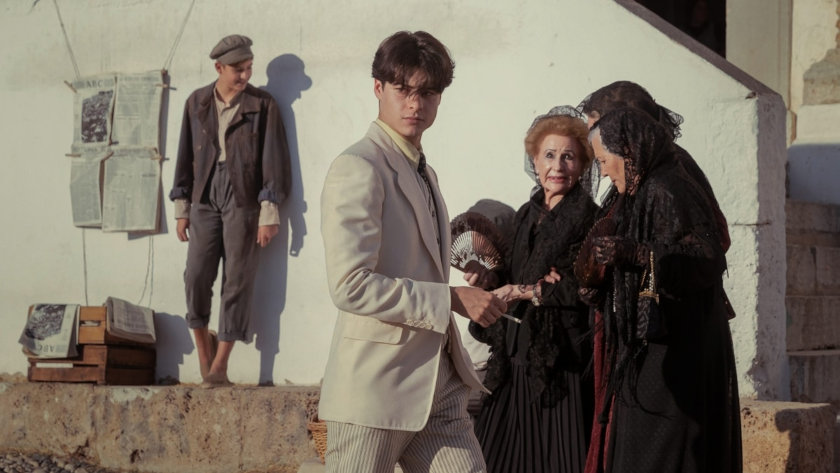
Yet the film starts with Sebastian, a local band member and trumpeteer in a small Granada village, who's waiting to welcome the Italian fascists; things will take an unprecedented turn (and give one of the film's early goosebump sequences), and will have Sebastian climb upon the statue of another gay martyr, the saint Sebastiane, to save his life. His encounter with the deeply wounded and guarded hunk and prisoner-of-war Rafael (Miguel Bernardeau) -who has a story of his own- will turn the tables for the new young trumpeteer, now a Nationalist soldier.
The third story cuts to 2017: Alberto (Carlos González), a gay historian and former playwright, is ready to find all queer references in early 20th-century Constantinople music, but can't face his hardened mum (Lola Dueñas) when his grandfather's past comes back to haunt them. Suddenly, Alberto has to move from Grindr's "Sex now" status to a whole history he has never experienced; and, as writer and historian Isabelle Durand (Glen Close) will inform him, Spaniards are never good at writing their own history.
The three stories are edited with tight knots from scene to scene (Los Javis have a big TV experience handling different subplots together- the trans appreciation series 'Veneno' (2020) being their justly most celebrated work). In a film that lasts 159 minutes, there are hardly any moments of lapse -take an exception for the film's third part and some of its most Lorca-inspired, not always successful, poetic reality sequences. The stories interlock nicely, with Alberto's story offering the contemporary grounding (and humor) that would otherwise have made this historical melodrama too sad to digest. The women characters, strategically placed in the film's stories, shine with their one- or two-scene presence. Lola Dueñas is the perfect Almodóvarian character under prolonged nervous breakdown (Almodóvar is also credited as the film's associate producer and has a sweet mention as well). At the same time, Glen Close is mostly underused; she rises above the puppet mouth for queer defense -and Cruz is the singer and performer in the Civil War who knows how to be both on stage and in its sidelines.
Yet the film's main characters are the boys, and the Javis can range cinematographically from a Claire Denis' 'Beau Travail', less stylized, but equally steamy army group relaxing sea sequence to a bunch of seductive sailors in the sunshine (in the film's Lorca-inspired story). More democratic in their choice of characters and lodgings (no Luchino Visconti queer aristocrats here) and less big-town-heavy dramatists (as Almodóvar is), they still try to carve out a path between the now and the past, history and its appropriation.
Sometimes they try too hard; everything looks very neat as a Rubik's Cube that needs to be solved to the last extent, and history (even Lorca himself, in the film's grainy black-and-white segment) needs to reveal all its secrets to the characters before saying the final adieu -a tendency that goes in difference with the unfinished love stories they choose to tell. Drama still exists, though; and the 1937 romance (Rafael Rodríguez Rapún is a real character, a footballer and a Republican who died in a 1937 Cantabria battle), its furtive glances and touches still tell the story of a love that better not speak its name -at least, at those times.
'La Bola Negra' has excellent movement in action that compensates for the three central characters, all lost in their repressed/unacknowledged stories. The film's choreography is never static and goes where the characters cannot. The three leads are universally confident in their non-unsatisfied state of longing. Even though its history dialogue tends to self-satisfy the directors' questions, 'La Bola Negra' has an astute sense of timing, a problem of queer longing laid out open in its most urgent and direct version, and a lot of well-meant, ordinary rapport with the 'common people', the ones who want to imagine different lives but lack the tools. This queer performativity and the characters' play-acting give the film its unique tone and importance.
Vassilis Kroustallis

Film Is A Fine Affair details the views and reviews of Vassilis Kroustallis, on independent cinema. Legally represented by Scheriaa Productions